Cover Letter Generator: Create a Job-Winning Letter Fast

A cover letter generator can save you an evening of staring at a blank page, but only if you use it as part of a system rather than a shortcut around one. The letter that actually gets read is the one that lines up with your resume and speaks directly to the job description in front of it.
What a Cover Letter Generator Actually Does
A cover letter generator takes the raw material you already have, your work history, the role you're applying for, and the specific job posting, and turns it into a structured draft you can edit. It's not meant to write your story for you. What it does well is handle the mechanical parts: formatting, transitions, opening and closing lines, and the logical flow from "here's who I am" to "here's why I fit this role."
The good ones ask for context before they generate anything: your target job title, the company, key requirements from the posting, and a few of your relevant achievements. The output is a draft built around that context, not a template with your name dropped in. That distinction matters, because most of the letters recruiters reject aren't badly written. They're just generic.
Why Generic Cover Letters Get Rejected by Recruiters and ATS
Recruiters skim. A hiring manager looking through a stack of applications for one role isn't reading full paragraphs, they're scanning for whether you understood the job and whether your background actually matches it. A cover letter full of broad statements like "I am a hardworking professional with strong communication skills" tells them nothing, because it could apply to any candidate for any job.
Applicant tracking systems compound the problem. Many ATS platforms parse cover letters for keyword relevance the same way they parse resumes. If your letter doesn't mention the tools, certifications, or terminology used in the posting, it can score lower even if you're genuinely qualified. A cover letter that ignores the job description's language is invisible to both the software and the person reading it after.
This is where most cover letter tools fall short. They'll generate a polished letter, but if it's disconnected from your actual resume or from the specific posting's keywords, you've just automated the generic problem instead of fixing it. Before you send anything, it's worth checking whether your resume itself is even getting through the screening stage. Our guide on building a resume that passes ATS checks walks through what these systems actually scan for.
How to Use a Cover Letter Generator Step by Step
The process works best in this order:
- Start with the job posting. Paste in the actual description, not a summary. The specific phrasing matters.
- Feed in your real achievements, not just job titles. "Managed a team" is weaker input than "Led a team through a product launch that cut onboarding time significantly."
- Generate a first draft and read it as if you're the hiring manager, not the applicant.
- Compare it against your resume to make sure the two documents tell a consistent story.
- Edit for voice. Cut anything that sounds like it could have been written by anyone else applying to the same role.
- Proofread once more, out loud. Generated text can read smoothly on screen and still sound stiff when spoken.
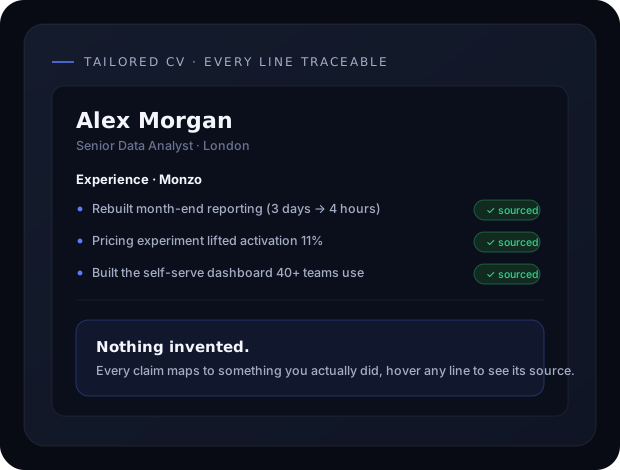
The strongest inputs come from having your career history organized somewhere consistent, rather than reconstructing it from memory every time you apply. Keeping a running record of your roles, metrics, and accomplishments in one place, like LairIQ's Career Memory, means every letter you generate pulls from the same accurate source instead of whatever you happen to remember that day.
Matching Your Cover Letter to the Job Description and Resume
This is the step almost every standalone cover letter tool skips, and it's the one that actually determines whether your application gets a callback. A cover letter shouldn't just sound professional. It should mirror the priorities in the job posting and reinforce, not repeat, what's already on your resume.
Practically, that means:
- Pull two or three requirements directly from the posting and address each one with a specific example.
- Use the same terminology the job description uses for tools, methods, and role responsibilities. If they say "stakeholder management," don't write "collaboration" instead.
- Make sure the achievements you highlight in the letter also appear, in more detail, on your resume. A cover letter that mentions a project your resume doesn't back up looks inconsistent.
- Keep the letter focused on the two or three things that matter most for this specific role, not a full recap of your career.
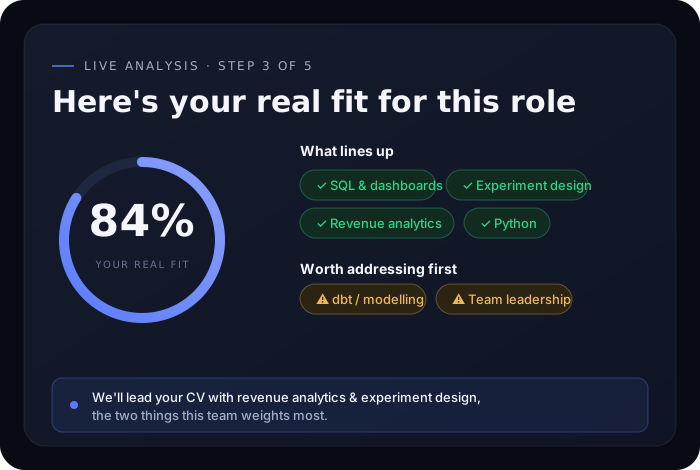
Before you invest time customizing a letter for a role, it's worth confirming the role is actually a match for your background. LairIQ's Job Match Score compares your experience against a specific posting and flags where the gaps are, so you're not writing a persuasive letter for a job you're not close to qualified for.
A cover letter shouldn't just sound professional. It should mirror the priorities in the job posting and reinforce, not repeat, what's already on your resume.
What to Edit Before You Hit Send
No generated draft should go out unedited. At minimum, check for:
- Specificity. Replace vague claims with numbers, outcomes, or named projects wherever you can.
- Company name and role title. Generated drafts sometimes leave placeholder text or generic phrasing where a specific detail belongs.
- Tone consistency. A letter that shifts from formal to casual mid-paragraph reads as unedited.
- Length. Three to four short paragraphs is the ceiling for most roles. Longer isn't more convincing.
- The opening line. Cut anything that starts with "I am writing to apply for." Open with the strongest relevant fact about you instead.
Cover Letter Generator vs Writing From Scratch: Time and Quality Tradeoffs
| Approach | Time investment | Typical result |
|---|---|---|
| Writing from scratch each time | Significant time per letter | Strong if you're a confident writer, but slow and inconsistent under deadline pressure |
| Reusing one old letter with minor edits | Very little time | Fast, but usually too generic to match the specific role |
| Generator plus manual editing and job-match review | Moderate time | Consistent quality, tailored to the posting, scales across multiple applications |
The real tradeoff isn't generator versus human writing. It's whether you're willing to spend a few extra minutes tailoring the output. A generator without editing is barely better than a template. A generator paired with resume alignment and job-description matching gets you most of the quality of a from-scratch letter in a fraction of the time.
Common Mistakes to Avoid With Generated Cover Letters
- Sending the same letter to multiple companies with only the name swapped. Recruiters can tell.
- Letting the tool invent achievements. If a claim isn't true or isn't backed by your resume, cut it.
- Ignoring the job posting's actual language in favor of generic industry buzzwords.
- Ending with a weak closing line. "I look forward to hearing from you" is fine, but pairing it with one concrete next step reads stronger.
- Skipping the resume comparison. A polished letter next to a mismatched or unoptimized resume undercuts itself. If you haven't reviewed your resume's structure recently, our piece on choosing the best resume builder is a good place to start before you finalize your application package.
- A cover letter generator is most effective when it draws from real, specific achievements, not vague summaries.
- Matching your letter's language to the job posting matters as much for ATS parsing as for the human reader.
- Always cross-check your letter against your resume so the two documents tell one consistent story.
- Editing time is where quality actually comes from; a raw draft is a starting point, not a finished letter.
FAQs About Cover Letter Generators
Summary
A cover letter generator earns its place in your job search when it's treated as one part of a matched application, not a standalone fix. Draft with real achievements, tailor the language to the job posting, verify the letter and resume tell the same story, and edit before you send. Do that consistently and you'll spend less time per application while sending stronger ones. For a faster way to pull all of this together into one tailored, evidence-backed application, try LairIQ's Application Builder.