Cover Letter Template 2026: Free, ATS-Friendly Formats

A good cover letter template in 2026 isn't a decorative wrapper around a greeting and a closing line. It's a structure that pulls three things into alignment: the job description's language, your resume's evidence, and a narrative a hiring manager can act on in under a minute.
Three things separate a template that works from one that just fills space:
- It mirrors keywords without copying them verbatim. If the job posting says "cross-functional stakeholder management," your letter should reflect that concept using your own accomplishment, not just repeat the phrase.
- It references specific, checkable facts from your resume. A number, a tool, a team size, a result. Vague enthusiasm reads as filler; a specific detail reads as proof.
- It's short enough to be read in full. Recruiters skim. A template built for 2026 hiring speed assumes a few hundred words of actual reading, not a full page of paragraphs.
Templates that ignore these three things end up generic, and generic is what gets a cover letter skimmed for a few seconds and discarded. The goal isn't to sound impressive. It's to sound like the right person for this exact opening.
- A cover letter template only works if it's built to be edited per job, not reused as-is.
- The strongest letters repeat the same skills and language your resume already emphasizes.
- Length and specificity matter more than tone or creativity.
The 3 Cover Letter Formats: Traditional, Modern, and Career-Change
Not every applicant needs the same structure. Here's how the three most useful formats differ and when each one fits.
| Format | Best for | Structure |
|---|---|---|
| Traditional | Corporate, finance, government, legal roles | Formal greeting, three paragraphs (intro, experience match, close), formal sign-off |
| Modern | Tech, startups, marketing, creative roles | Shorter paragraphs, direct opening line, bullet point for key wins, conversational close |
| Career-Change | Anyone pivoting industries or functions | Leads with transferable skills, explains the pivot directly, ties old experience to new role requirements |
The traditional format is the safest default when you're unsure what a company culture expects, especially for larger or more conservative employers. The modern format works when the job posting itself sounds informal or when you're applying somewhere that values concise communication over polish. The career-change format is the one most people get wrong: they either over-explain the pivot or ignore it entirely. The right approach names the transition plainly in the first two sentences, then spends the rest of the letter proving the skills transfer.
Free Cover Letter Template (Copy-Paste Version)
Use this as a starting structure, not a finished product. Replace every bracket with something specific to you and the job.
``` [Your Name]
[Your Email] | [Your Phone] | [City, State]
[Date]
[Hiring Manager Name, if known] [Company Name]
Dear [Hiring Manager Name or "Hiring Team"],
I'm applying for the [Job Title] role at [Company Name]. In my current role as [Your Current Title] at [Current Company], I [specific accomplishment with a number or result], which directly matches the [specific requirement from the job posting] you're looking for.
Over the past [X years], I've [core responsibility or skill relevant to the job], including [specific example: a project, a tool, a team you led]. This experience taught me [insight or skill], which is exactly what this role at [Company Name] requires when it comes to [specific responsibility from the posting].
I'm drawn to [Company Name] because [specific, researched reason: a product, a mission, a recent initiative]. I'd welcome the chance to bring [specific strength] to your team and discuss how my background in [relevant area] fits what you're building.
Thank you for your time and consideration.
Sincerely, [Your Name] ```
This template works across most industries because it's built around evidence, not adjectives. Nowhere does it say "hardworking" or "team player." Every sentence either states a fact or ties that fact to something in the job posting.
How to Match Your Cover Letter to the Job Description and Your Resume
The biggest mistake in cover letter writing isn't grammar or formatting. It's disconnection: a letter that could have been sent to any company for any job, sitting on top of a resume that was actually tailored.
To fix that, treat the job description as a checklist before you write a single sentence:
- Pull the top five requirements from the posting, usually found in the first two bullet points and any "must have" language.
- Match each requirement to a line on your resume. If a requirement has no matching evidence, don't force it into the cover letter. Address it honestly or skip it.
- Pick the two strongest matches and build your cover letter's middle paragraph around them. Don't try to cover all five; a letter that tries to say everything ends up saying nothing clearly.
- Reuse the resume's exact numbers. If your resume cites a specific result, the cover letter should reference that same figure, not a vaguer version of it. Consistency between the two documents is what makes both feel credible.
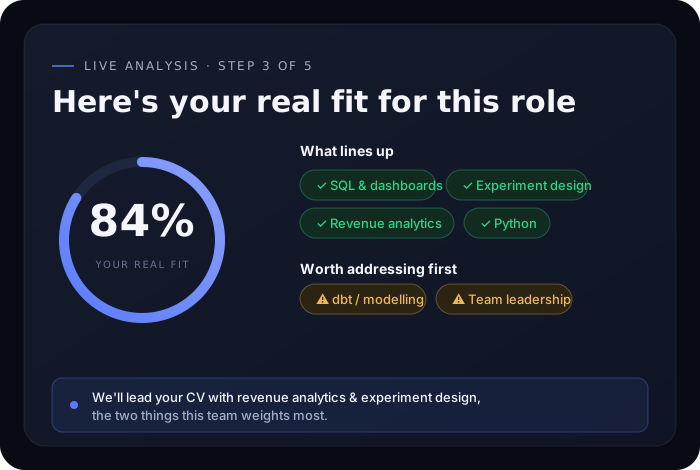
This is also where most candidates waste time guessing whether their resume is even getting through the initial screen in the first place. Before you spend an evening writing a tailored letter, it's worth checking whether the resume behind it will actually clear an applicant tracking system. The ATS Resume Checker shows you exactly which keywords and formatting issues might be costing you a screen-out before a human ever reads your cover letter at all.
Common Cover Letter Mistakes That Get Applications Ignored
Most rejected cover letters aren't rejected for being poorly written. They're rejected for being interchangeable. Here's what causes that:
- Restating the resume line by line. A cover letter should add context and narrative, not repeat a list of duties.
- Opening with "I am writing to apply for..." It's the weakest possible first line because it delays the actual point.
- Overusing adjectives instead of evidence. "Passionate," "driven," and "results-oriented" mean nothing without a specific result attached.
- Wrong company name or role title. This happens more than people admit, usually from reusing a template without checking every field.
- No connection to the specific job posting's language. Letters that ignore the actual requirements read as mass-produced, even when they aren't.
- Excessive length. A second full page rarely gets read. If your letter runs long, cut it before you send it.
Cover Letter Template by Situation: Entry-Level, Career Change, Executive
The core structure from the copy-paste template above holds for everyone, but the emphasis shifts depending on where you are in your career.
Entry-level. Lean on coursework, internships, projects, and any measurable outcome from school or part-time work. Instead of "I have strong communication skills," write "I presented findings from a semester-long research project to a panel of faculty." Specificity substitutes for years of experience you don't have yet.
Career change. Open with the pivot directly: "After [X years] in [old field], I'm moving into [new field] because [honest, specific reason]." Then spend the body paragraph translating old experience into new-field language. A project manager moving into UX design should talk about stakeholder alignment and iteration cycles, not just "managing projects."
Executive. Cut the warmth, keep the results. Executive cover letters should read like a one-page business case: what you led, what changed as a result, and what you'd bring to this specific mandate. Avoid restating your full career history; pick the two or three moments most relevant to the role you're targeting and go deep on those instead of wide across everything.
Formatting and Length Rules Recruiters Actually Care About
Formatting matters less for style points and more for whether the letter gets read at all.
- Length: Keep it to roughly a page or less. Anything longer risks getting skimmed instead of read.
- Font: Match your resume's font for visual consistency across the application. Standard, readable fonts at a comfortable reading size.
- Paragraphs: Three to four short paragraphs, no single block of unbroken text.
- File format: PDF unless the application system specifically requests a Word document. PDFs preserve formatting across devices and ATS platforms.
- No headers or footers with contact info. Some ATS parsers skip content placed in header or footer fields entirely, meaning your contact details might never get extracted.
- File naming: Use your name and the word "cover letter," for example FirstnameLastname_CoverLetter.pdf, so recruiters can identify it instantly in a folder of applications.
These rules exist because cover letters, like resumes, often pass through the same document parsing systems before a person sees them. A letter that's visually complex or oddly structured can lose formatting or get misread in the same way an over-designed resume does. If you haven't already checked how your resume itself holds up, this guide to building a resume that passes ATS checks in 2026 covers the same formatting logic in more depth.
How to Pair Your Cover Letter With an ATS-Optimized Resume
A cover letter and a resume should function as one coordinated application, not two separate documents written at different times with different goals. The resume proves you meet the requirements; the cover letter explains why those requirements matter to you and how they connect into a coherent story.
The most effective way to keep both aligned is to build them from the same source material at the same time. When you draft a resume for a specific posting and then write the cover letter as a separate afterthought, small inconsistencies creep in: different numbers, different emphasis, sometimes even different job titles. Those inconsistencies are exactly what makes an application feel unpolished to a hiring manager, even when both documents are individually strong.
Before submitting anything, it's also worth confirming the job itself