Interview Preparation: The Complete 2026 Guide

Most interview preparation advice treats the interview as a separate event from the application. It isn't. The interview is the part of the process where someone finally reads your resume out loud and asks you to defend it. Everything you claimed on paper, and everything the job description asked for, comes up in that room or on that call. Preparing well means connecting those two documents, not memorizing generic answers.
Why Interview Preparation Matters More Than You Think
Getting the interview is already a filter. Something in your resume and cover letter convinced a recruiter or hiring manager that you might be the right person. The interview exists to test that impression against reality. Interviewers aren't just checking whether you can talk about yourself confidently. They're checking whether your actual experience matches what the role requires and what your application implied.
This is why generic prep, a list of "top interview questions" with textbook answers, only gets you so far. The questions that actually matter in your interview are shaped by three things: the job description, your resume, and the specific gaps or overlaps between the two. An interviewer who sees years of experience in one industry but is hiring for a different one will ask about that transition directly. Someone who sees a resume heavy on individual contributor work for a role that requires managing people will ask about leadership, even if your resume never used that word.
Preparing for an interview should mean preparing for your interview, based on your background and this specific job, not a hypothetical one.
Step 1: Research the Company and Role Thoroughly
Start with the job posting itself. Read it twice: once for the responsibilities, once for the language. Job descriptions tell you what the team is worried about. If "cross-functional collaboration" comes up repeatedly, expect questions about working with other departments. If the posting emphasizes a "fast-paced environment," expect questions about handling ambiguity or shifting priorities.
Then look outside the posting. Check the company's recent news, product launches, or public statements about direction. Look at the team structure if it's visible on LinkedIn. Understand what the company actually does for its customers, not just its mission statement. You don't need to become an industry analyst, but you should be able to answer "why this company" with something more specific than "I've heard good things."
Pay attention to the seniority level implied by the posting too. A "senior" title with junior-level responsibilities, or the reverse, tells you something about how the role was scoped. That mismatch often becomes a topic in the interview itself.
Step 2: Align Your Resume and Job Fit Before You Walk In
This is the step most candidates skip, and it's the one that matters most. Before you prepare answers, you need to know exactly where your resume overlaps with the job description and where it doesn't. Interviewers build their questions around that gap, whether they realize it or not.
Go through the job posting line by line and match each requirement to something concrete in your background. If a requirement has no match, that's not a reason to panic, it's a reason to prepare a specific, honest answer for when it comes up. If a requirement has a strong match, make sure that story is easy for you to tell clearly and briefly, because you'll likely be asked about it directly.
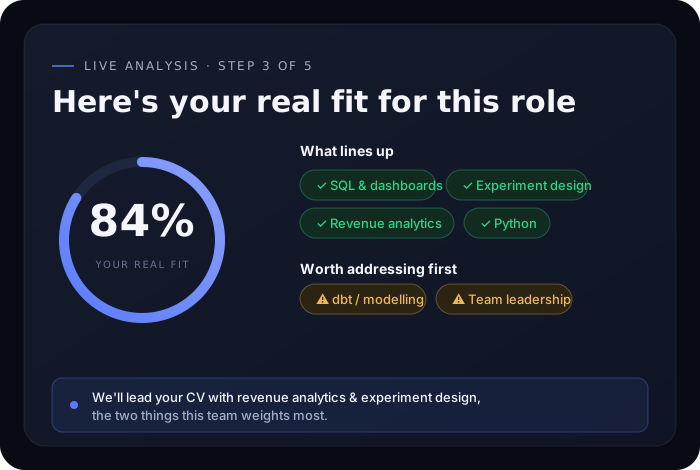
This is exactly what a job-fit analysis is built to surface. Instead of guessing which parts of your resume the interviewer will focus on, you can see how your experience scores against the specific job description, section by section. That turns interview prep into something targeted: you know which areas are your strongest talking points and which ones need a prepared, confident answer rather than an improvised one.
If you're not sure your resume is even communicating your experience clearly in the first place, it's worth running it through an ATS resume checker before the interview stage, not just before you apply. A resume that reads well to a person but confuses a tracking system may also be organized in a way that makes it harder for an interviewer to quickly locate your relevant experience.
Step 3: Prepare Answers for Common and Behavioral Questions
Once you know where your resume aligns with the job and where it doesn't, you can prepare answers that are grounded rather than generic. Common questions like "tell me about yourself," "why do you want this role," and "what's your biggest weakness" all have better answers when they're tied to the actual job description in front of you.
"Tell me about yourself" should function as a short walk through your career that ends at the door of this specific role. It's not your whole life story. It's the short version that explains why the job posting and your background are a logical match.
Behavioral questions, the ones that start with "tell me about a time when," deserve special attention because they map directly to the requirements in the posting. If the job requires handling difficult stakeholders, expect a question about conflict. If it requires meeting deadlines under pressure, expect a question about a time things went wrong. Go back to your job-fit results and, for each major requirement, have one real example ready.
For deeper prep, an Interview Readiness Check looks at your resume against the job description and points you toward the kinds of questions this specific interview is likely to raise, along with where your own experience gives you strong material to answer them. It's a way to prepare for your interview, not a generic one.
Step 4: Use the STAR Method to Structure Your Stories
Having the right examples isn't enough if you can't tell them clearly under pressure. The STAR method, Situation, Task, Action, Result, gives your answers a shape that's easy to follow and easy to remember when you're nervous.
Situation and Task set up the context briefly, in a sentence or two. Action is the part to spend the most time on: what you specifically did, not what your team did. Result closes the story with an outcome, ideally something measurable or at least clearly observable.
The most common STAR mistake is spending too long on the situation and too little on the action. Interviewers are trying to evaluate you, not your former team or company, so the "what did you do" part needs to be the center of gravity in every story. Practice trimming your setup down so the action gets the airtime.
Keep a handful of STAR stories ready that cover different skills: a leadership moment, a conflict or setback, a technical or process improvement, and a result you're proud of. Map each one back to a specific requirement from the job description so you're not searching for a story mid-interview.
Step 5: Prepare Smart Questions to Ask the Interviewer
The questions you ask at the end are not a formality. They're part of the evaluation. A candidate who asks sharp, specific questions signals that they've actually thought about the role rather than just wanting a job.
Avoid questions that are easily answered by the company website or the job posting. Instead, ask about things only someone inside the team would know: how success is measured early on, what the biggest challenge facing the team is right now, or how the role has evolved since it was created. If you noticed something ambiguous or interesting during your research, ask about it directly.
Save at least one question about growth or team dynamics, and one about the work itself. Avoid asking about salary or benefits at this st