What Is a Cover Letter in a Job Application?

A cover letter is a short, one-page document you send alongside your resume when applying for a job. It explains who you are, why you want the role, and why your background makes you a strong fit, in your own words rather than in the bullet-point format a resume forces on you.
What Is a Cover Letter in a Job Application?
A cover letter is a brief, personalized letter that introduces you to an employer and connects your experience to the specific job you're applying for. Where a resume lists what you've done, a cover letter explains why it matters for this particular role and this particular company. It's typically three to four paragraphs, addressed to a hiring manager or team, and submitted alongside your resume as part of a single application.
Think of it as the opening argument in your case for why you should be interviewed. It doesn't repeat your resume. It interprets it, giving the reader context they can't get from a list of job titles and dates alone.
Why Employers Ask for a Cover Letter
Employers ask for cover letters because a resume shows what you did, but not always why you did it or what you were thinking when you made career decisions. A cover letter fills that gap. It tells a hiring manager whether you understand the role, whether you can write clearly under a professional register, and whether you actually want this specific job rather than any job that will have you.
It's also a practical filter. A candidate who takes the time to write a thoughtful, tailored letter signals genuine interest. A generic, copy-pasted one signals the opposite, and experienced recruiters can tell the difference within a sentence or two.
Some employers weigh cover letters heavily. Others barely glance at them but still expect one to be present, since its absence reads as a missed step. Either way, submitting a clear, relevant letter costs you little and rarely hurts your chances.
Cover Letter vs. Resume: What's the Difference?
The two documents work together but serve different jobs.
| Document | What it does |
|---|---|
| Resume | Lists your work history, skills, and measurable achievements in a scannable, structured format |
| Cover Letter | Explains your motivation, connects your background to the specific role, and adds context a resume can't |
A resume is built for speed. Recruiters and applicant tracking systems scan it quickly, looking for keywords, job titles, and dates. A cover letter is built for persuasion. It's read more slowly, usually by a person who has already decided your resume is worth a closer look.
If you're unsure whether your resume itself is clearing the first hurdle, an ATS resume checker can tell you whether an applicant tracking system will actually surface your application before a person ever reads your cover letter.
What a Cover Letter Typically Includes
A standard cover letter has four parts:
- An opening that states the role and your interest. Name the position, where you found it, and one sentence on why it caught your attention.
- A middle section connecting your experience to the job. Pick one or two accomplishments from your resume and explain the impact, ideally with a number or outcome attached.
- A close addressing why this company specifically. This is where generic letters fall apart. Naming the company's product, mission, or recent work shows you did more than swap out a template.
- A sign-off with a call to action. Thank the reader, restate your interest, and invite next steps.
Formatting matters too. Use a standard business letter structure, keep it to one page, and match the tone of the job posting: more formal for corporate roles, more conversational for startups. If you want a starting structure rather than a blank page, a cover letter template built for current hiring practices gives you the skeleton without dictating your words.
When Is a Cover Letter Required (and When It's Optional)?
Some job postings explicitly require a cover letter and will say so. Others mark it optional, and a smaller group don't mention it at all. As a general rule:
- Always submit one if the posting requests it, even if the upload field is marked optional.
- Strongly consider one for roles at smaller companies, in competitive fields, or when you're changing careers and need to explain a nonlinear path.
- Skip it only when an application system has no field for it and the instructions explicitly say not to include one.
Common Mistakes to Avoid
Most weak cover letters share the same few problems:
- Restating the resume line by line. If your letter just repeats your job titles in sentence form, it's adding nothing.
- Using a generic template with no company-specific details. "I am excited about this opportunity at your company" reads as filler because it could apply anywhere.
- Opening with "To Whom It May Concern." Take the extra time to find a name or at least a team or department.
- Writing more than one page. Hiring managers skim. A long letter signals you don't know how to edit yourself.
- Focusing on what you want instead of what you offer. Talk about the value you bring before you talk about your own career goals.
These mistakes are easy to make when you're rushing through multiple applications, which is exactly when a second look is worth the time.
How to Write a Cover Letter Step by Step
- Read the job posting closely. Pull out the two or three requirements that matter most and note the exact language they use.
- Pick your strongest matching accomplishment. Choose one story from your resume that proves you meet the top requirement, ideally with a measurable result.
- Draft the opening paragraph. State the role, where you saw it, and a specific reason you're applying to this company.
- Write the body paragraph. Connect your chosen accomplishment directly to what the posting asked for. Avoid vague claims like "team player" without evidence behind them.
- Write the closing. Reaffirm interest, thank the reader, and note you'd welcome the chance to discuss the role further.
- Edit for length and tone. Cut anything that doesn't serve the argument that you're the right fit. Read it aloud once to catch stiff phrasing.
- Check it against the resume you're sending. The two documents should tell a consistent story, not contradict each other on dates, titles, or achievements.
If you'd rather work from a draft than a blank page, a cover letter generator can produce a first pass based on your resume and the job posting, which you then edit into your own voice. For a step-by-step breakdown with more examples, see our full cover letter guide.
A cover letter is your case for why you should be interviewed, not a second copy of your resume.
For a faster path, LairIQ's Application Builder produces a tailored cover letter and resume pairing based on the specific job posting you're applying to, so the two documents reinforce each other instead of repeating the same information twice.
- A cover letter explains why your experience fits a specific role; a resume just lists what you've done.
- Include one whenever it's requested, and default to including it even when it's marked optional.
- Keep it to one page, name the company specifically, and lead with your strongest relevant accomplishment.
- Check your resume separately with an ATS resume checker so both documents actually get read.
Frequently Asked Questions
Summary
A cover letter is a short, tailored letter that explains why you want a specific role and why your background fits it, submitted alongside your resume rather than instead of it. Employers use it to gauge motivation, communication skill, and genuine interest in their company specifically. The strongest letters skip generic phrasing, lead with one strong, specific accomplishment, and stay under a page. Once you've written yours, check that your resume is telling the same story and passing the technical screens employers use before a person ever reads it.
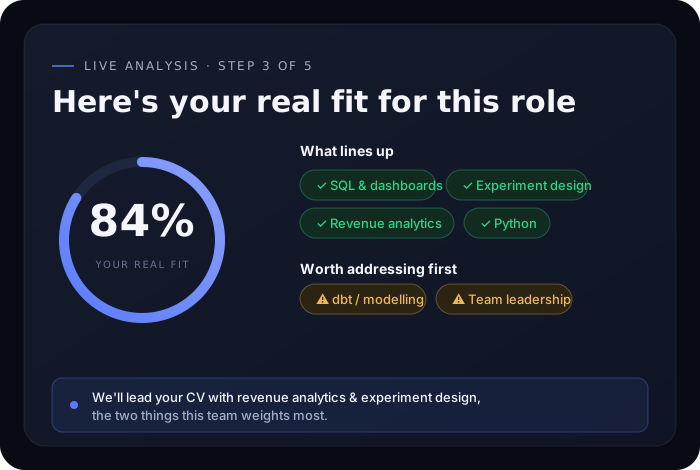
Before you submit, it's worth confirming the job itself is a real match for your background. LairIQ's Job Match Score compares your resume against the posting and shows you where the gaps are, so you spend your cover letter effort on roles worth pursuing.